

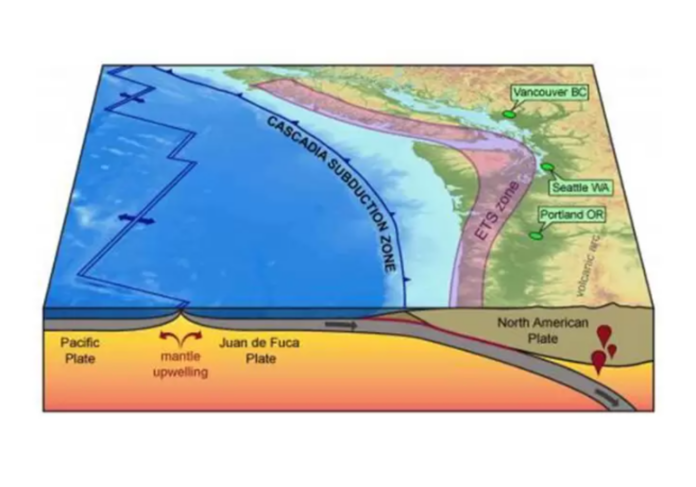
Vancouver Island, coastal BC, Washington, Oregon and northern California could find themselves in the splash zone of the anticipated, but less-than-exciting ‘big one’ earthquake.
According to a study by Columbia Climate School, these regions all lie along a 600-mile-long stretch of Pacific ocean floor that has been slowly pushing eastward underneath the North American continental shelf.
This area is called the Cascadia Subduction Zone, and is a volatile place where tectonic plates are pushing against each other in a highly pressurized and dangerous way.
When the plates lock up and put immense stress on one another. That pressure is eventually released, which has the potential to cause massive earthquakes and subsequent tsunamis.
According to Columbia Climate School scientists, in the Cascadia Subduction Zone, massive quakes occur historically around every 500 years—give or take one or two hundred years. The last big earthquake in this zone happened in around 1700.
This means it could happen at any time, but is most likely 100 to 200 years off.
Columbia scientists say there is no such thing as predicting an earthquake, but those who study seismology keep busy with running impact scenarios and studying tectonic plates around the globe.
Innovations continue to push the field further as well, such as a research vessel towing the latest instruments along the Cascadia Subduction Zone to get a comprehensive survey of the ocean floor.
“The models currently in use by public agencies were based on a limited set of old, low-quality 1980s-era data,” said Suzanne Carbotte, a marine geophysicist at Columbia University.
She added that the zone the big one will come from has a much more complex geometry than was assumed.
One key finding from Colombia’s recent research is that the Cascadia Subduction Zone is not just one continuous shelf, but at least four segments.
Columbia’s study found that each segment may not be impacted by the movements of the others.
This means that the last big one may not have been a rupture of the whole zone, but only a portion of it.
The researchers honed in on one segment in particular which runs from southern Vancouver Island along Washington and ending around the Oregon border.
The evidence gathered by the Columbia researchers suggested that this segment’s conditions make it more likely to rupture along its entire length at once.
This means it is potentially the most dangerous section of the Cascadia Subduction Zone.
In addition to this, the study found that the shelf segment extends directly under Washington’s Olympic Peninsula, which would make the shaking from an earthquake potentially catastrophic.
Scientists from the Geological Survey of Canada say that the tsunami aspect of what would happen if a rupture occurred is still a work in progress, but it would likely be of great impact to southern Vancouver Islanders.
💬 Join the conversation
No comments yet — be the first to start the conversation